



Sustainability in the Netherlands is often confused with lifespan. Lifespan can contribute to sustainability, but is certainly not the same thing.
The definition of sustainability
Sustainable means, among other things, ‘produced or obtained in a way that places as little burden as possible on the environment and nature,’ ‘placing minimal burden on the environment.’ In short: ‘relatively environmentally friendly,’ ‘resource-saving.’.
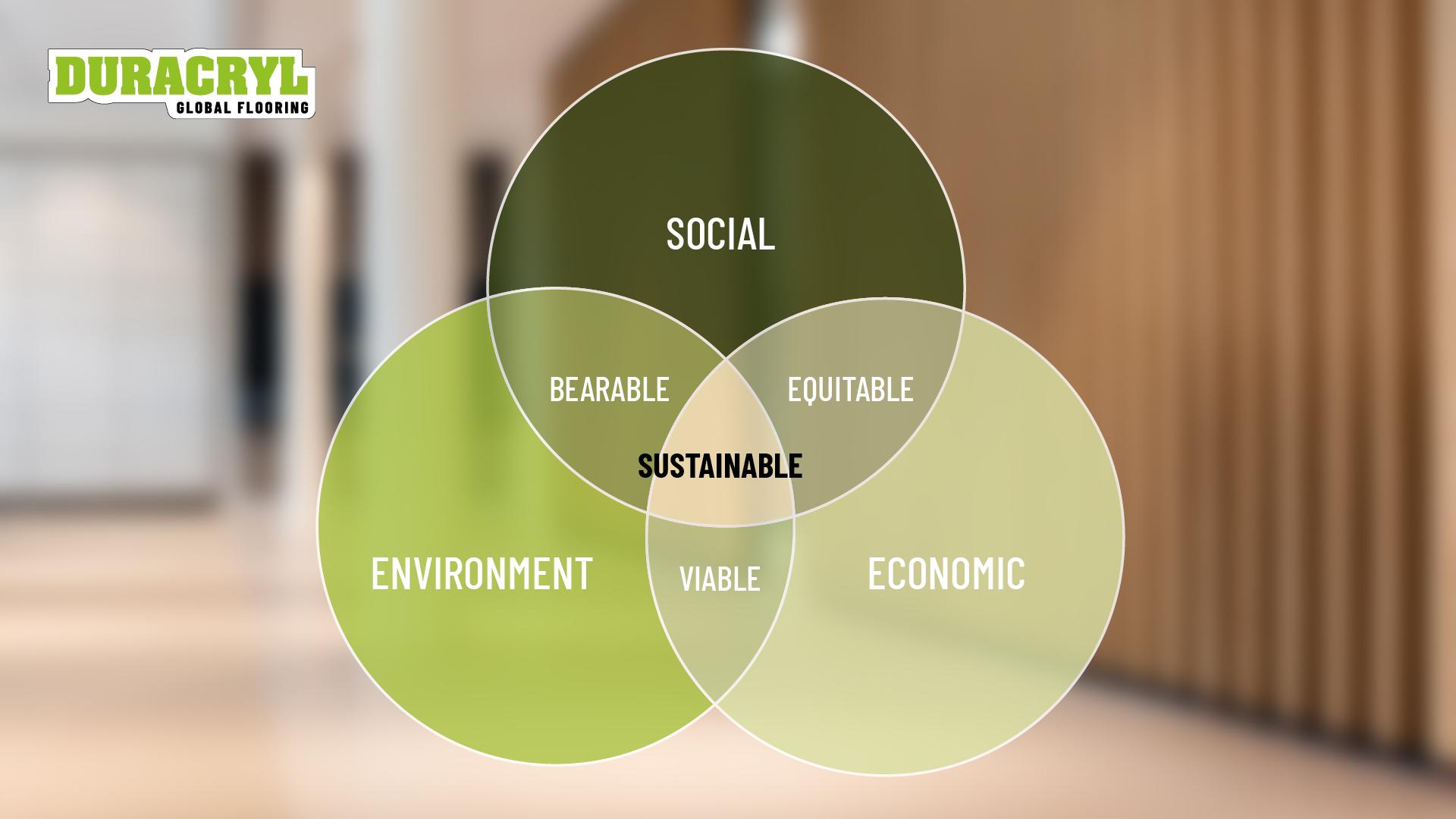
Sustainability is a broad concept, but in short, it comes down to the idea that in a sustainable world, people, planet, and profit are in balance with one another, so that we do not exhaust the earth.
The United Nations for environment and development defines sustainability as:
“development that meets the needs of the present without compromising the ability of future generations to meet their own needs.
In short: using the earth in such a way that future generations can also enjoy it. With sustainability, the earth can also bear the total of our consumption in the long term.
Floors that are primarily based on fossil raw materials (finite resources) such as vinyl / PVC, synthetic rubber, and epoxy terrazzo can never be sustainable according to this definition.
‘Climate Positive Flooring’
For the accountability of the impact of the carbon footprint For each flooring product, we use the definition of the Healthy Materials Lab at Parsons School of Design in New York, a leading authority in this field:
“Currently, there is no universal threshold for ‘low embodied carbon’ in flooring materials. After discussing this research with experts, we have set a rigorous standard that can meet 2030 emission goals. These products, labeled with ‘LEC’, embody below 5kg of CO2 per square meter.
All Duracryl products comply with this standard and are called ‘Climate Positive Flooring’.
By using Duracryl floors, you can contribute to significantly lower CO2 emissions compared to floors produced on a fossil basis, which generates a positive climate impact for future generations.
Check our products!